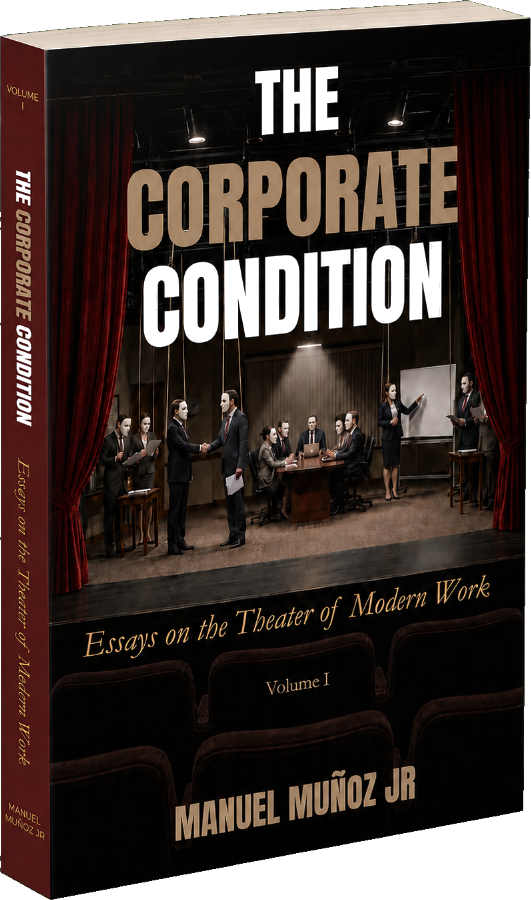
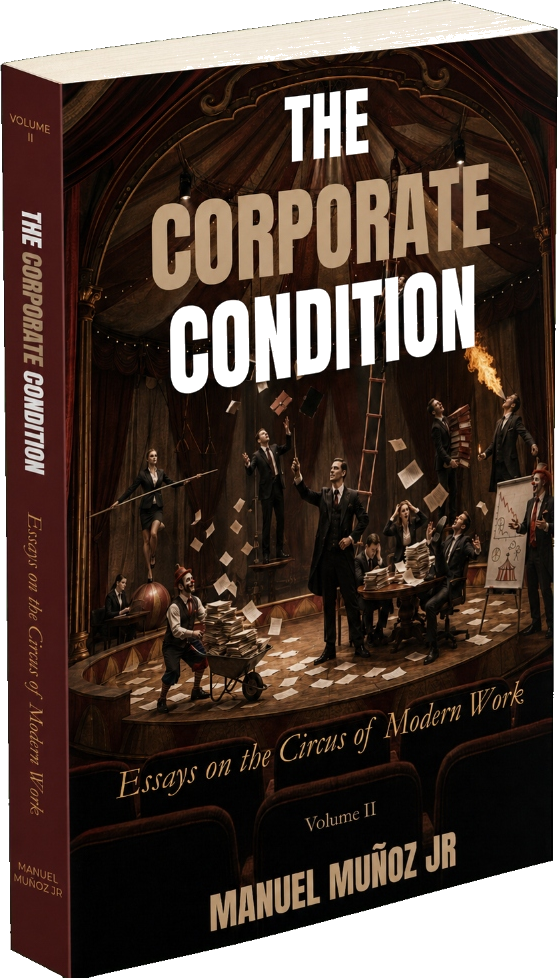
TBD
Essays on the Theater of Modern Work
Vol. I

By
Foreword by TBD
Praise from TBD & TBD
"A provocative collection examining the performative nature of corporate life, where employees become actors on the stage of modern capitalism, navigating scripted roles, power dynamics, and the human cost of organizational theater."
Available in Hardcover, eBook & Audio • Free Shipping on Signed Copies
The Corporate Condition: Essays on the Theater of Modern Work is a clear-eyed examination of the modern workplace—not as an engine of innovation or opportunity, but as a vast theatrical production where workers are cast into predetermined roles, directed by systems designed to extract performance while promising belonging, purpose, and growth.
This is not a self-help book. It offers no formulas, recipes, or step-by-step solutions for corporate success. What it provides instead is something more honest and more durable: intellectual and psychological self-defense—the pattern recognition necessary to navigate systems that don't operate in your interest.
Across five interconnected essays, Manuel Muñoz, Jr. pulls back the corporate curtain to reveal a world sustained by ritual, choreography, and carefully managed performance. What passes for culture is often manufactured belonging. What passes for leadership is frequently stage management. What passes for productivity is corporate kabuki theater—elaborate spectacle where gestures are exaggerated, scripts prewritten, and outcomes predetermined. In this world, workers find themselves performing roles crafted to maintain order and compliance, their authenticity quietly traded for the illusion of stability and advancement.
Drawing from more than twenty years inside corporations with global footprints, Muñoz exposes the contradictions that define modern work: the rhetoric of empowerment against the reality of surveillance; the promise of belonging against the machinery of alienation; the illusion of meritocracy against systems that reward performance over substance. Conference rooms, remote dashboards, and performance reviews appear not as neutral tools of commerce, but as stages where individuals enact roles written long before they arrived.
What makes this book different: Unlike academic theories, these essays arise from lived experience—the scars of misaligned incentives, the exhaustion of constant adaptation, the subtle distortions of identity produced by environments where optics override reality. And unlike typical career advice, the book doesn't prescribe what you should do. It reveals what is actually happening—clearly enough that you can make your own informed choices about how to navigate it.
Through sharp observation and unflinching honesty, Muñoz helps readers develop crucial self-awareness: the ability to distinguish between your own voice and institutional ventriloquism, between legitimate professional growth and manufactured compliance, between authentic engagement and performed enthusiasm. You'll learn to recognize the corporate Kool-Aid, the absurdity masquerading as strategy, and the daily contradictions of systems that promise meaning while delivering exhaustion.
The Corporate Condition doesn't promise you'll win the corporate game. It ensures you can survive it intact—clear-eyed, self-possessed, and unconsumed by systems designed to hollow you out. In a world saturated with aspirational advice that rarely survives Monday morning, this book offers something rarer: clarity without illusion, honesty without despair, and the awareness necessary to reclaim agency in your own working life.
"“This is not just a book — it is the blueprint for the next generation of business leaders.”
TBD
"
The foundational essay establishing the theatrical metaphor that structures the entire collection. Examines how corporate environments function as carefully constructed stages where every element—from open floor plans to dress codes to meeting rituals—serves not productivity but control. Opens with personal testimony about walking into a perfectly designed office and recognizing it as theater rather than workspace. Explores the physical mise en scène: how office layouts enforce visibility and eliminate privacy, how hot-desking destroys territorial stability, how architectural choices telegraph organizational power while masquerading as collaboration enhancement. Analyzes the costume requirement: business casual as uniform signaling conformity, the punishment for dress code violation, how appearance substitutes for competence. Examines corporate language as script: synergy, alignment, deliverables, bandwidth—terms that normalize extraction while obscuring meaning. Explores the audience problem: constant surveillance disguised as transparency, the performance of work rather than work itself, how presence becomes proxy for productivity. Documents casting call dynamics: hiring as mutual performance where both parties audition while pretending to evaluate, how authenticity is punished and performance rewarded. Investigates the masks employees wear: emotional labor disguised as professionalism, the gradual fusion of mask and identity, what happens when people can no longer locate themselves beneath the performance. Reveals backstage realities: what happens when the curtain drops, the exhaustion of sustained performance, the recognition that everyone is performing. Analyzes ideological control: mission statements as doctrine, values as compliance tools, how belonging initiatives manufacture consent. Examines human cost: the wasted potential of brilliant people performing rather than creating, the burnout that results from years of sustained theater, the alienation of living as character rather than person. Concludes with recognition that the corporate stage is not designed for work—it is designed to make work look like it's happening while extracting maximum compliance with minimum compensation.
A psychological autopsy examining how modern organizations have perfected voluntary compliance through manufactured belonging—creating systems that make employees perform community, demonstrate alignment, and prove engagement while maintaining the fiction that they're doing these things because they want to, not because the cost of refusing is too high. Opens with personal testimony about arriving skeptical, defending boundaries, certain of not becoming someone who confuses company loyalty with personal identity—and then gradually, imperceptibly, doing exactly that. Establishes corporate culture as the secular religion of our age: the organization as church, mission statement as scripture, all-hands meeting as sermon, manufactured belonging as opium making inadequate compensation tolerable. Explores the voluntary cage: control that never announces itself as control, operating through social pressure rather than explicit command, making compliance feel like authentic choice. Examines the architecture of voluntary compliance: how organizations cultivate conditions where submission emerges organically through birthday parties, happy hours, team events, volunteer days—each invitation functioning as obligation, each absence noticed and interpreted. Analyzes language as reality-shaping tool: synergy, alignment, engagement, culture fit, team player—terms that embed assumptions about what's natural and necessary while making certain thoughts difficult to think. Documents confession mechanisms: self-assessments as perpetual admission of inadequacy, engagement surveys as purity tests identifying resistance before it spreads, performance reviews as ritualized subordination. Traces HR's transformation from employee advocate to enforcement apparatus: how HR disappeared into the back office while culture work was automated or pushed to unpaid employee volunteers, how engagement platforms replaced human relationships, how surveillance became systematic while remaining invisible. Identifies the four tiers of architects who built this machinery: (1) The Architects who know exactly what they're building and have completed the moral calculus, (2) The Pragmatists who don't care if it's manipulation as long as metrics improve, (3) The True Believers who genuinely think they're helping but whose sincerity makes them immune to critique and more effective at perpetuating the system, (4) The Outsourcers who abdicate judgment to consultants promising transformation while delivering control. Examines "The Economic Truth They Won't Say Aloud": how culture substitutes for compensation, how manufactured belonging replaces the economic security that was systematically destroyed, how voluntary obligations extract unpaid labor, how title inflation provides ego compensation instead of raises, how manufactured urgency prevents reflection. Reveals the condition of awareness: understanding the cage doesn't automatically free you from needing what the system provides, seeing the manipulation doesn't eliminate dependence on manufactured belonging for community and purpose. Analyzes Stockholm Syndrome of corporate life: how trapped employees reframe captors as protectors, constraint as care, submission as chosen alliance because acknowledging the trap is psychologically unbearable when escape seems impossible. Not a guide to escape but a guide to seeing clearly what most people experience but cannot name.
A personal and philosophical examination of how workplace comfort—stable income, predictable routine, adequate performance—becomes a sophisticated trap that paralyzes ambition and wastes years of human potential. Structured as twenty-year journey from ambitious entry to comfortable stagnation to eventual recognition and departure. Opens with the seduction of arrival: first real job, stable paycheck, benefits, the relief of financial security after years of uncertainty. Documents the settling: how quickly "temporary until something better" becomes years, how the golden handcuffs tighten imperceptibly, how the fear of losing comfort outweighs the desire for meaning. Examines the contentment trap's mechanics: how organizations identify and retain adequate performers with just enough compensation to prevent departure but never enough to enable independence, how annual small raises create illusion of progress while ensuring continued dependence, how benefits and retirement accounts function as structural handcuffs. Explores the psychological mechanisms: how humans adapt to circumstances through hedonic adaptation, how loss aversion makes giving up known comfort harder than pursuing unknown opportunity, how sunk cost fallacy keeps people invested in careers they no longer want. Chronicles the years of recognizing the trap while remaining in it: the growing awareness that comfort is not the same as contentment, that stability is not the same as growth, that adequate performance in meaningless work is its own kind of failure. Documents the rationalizations: "I'll leave after the next promotion," "just one more year to hit my retirement contribution," "the economy is too uncertain to risk change now"—the endless deferral of action. Reveals what the trap costs: not just years but the best years, not just time but the energy and ambition that made risk-taking possible, not just opportunity but the very capacity to imagine different possibilities. Examines the collective dimension: how organizations depend on armies of adequately performing people who have accepted comfortable stagnation, how the system requires most people to remain trapped for it to function. Explores the difficulty of departure: how leaving comfort requires confronting not just financial risk but identity loss, social disruption, and the recognition of wasted years. Not prescriptive about whether to stay or leave, but diagnostic about what staying costs and why leaving is psychologically harder than it should be. Acknowledges that for some people at some life stages, the contentment trap is the least bad option—but argues that the choice should be conscious rather than default, strategic rather than drift.
An examination of middle management as structural weapon—the organizational layer designed to buffer executives from worker discontent while extracting compliance through proximity and performance of empathy. Opens with recognition that middle managers are simultaneously victims and perpetrators: trapped in impossible positions with responsibility but no authority, required to execute directives they often disagree with, performing care they cannot deliver while absorbing rage they did not cause. Establishes the useful idiot thesis: middle managers serve power while believing they're serving people, perpetuate systems they recognize as broken while convincing themselves they're improving them, function as organizational antibodies attacking exactly the kind of reform leadership claims to want. Documents the impossible position: caught between executive demands for results and team needs for support, given targets without resources, blamed for failures caused by structural constraints, rewarded for performance of leadership rather than actual leadership. Examines the performance requirements: middle managers must appear to care about people while delivering extraction, must seem to advocate upward while enforcing downward, must maintain morale while implementing decisions that destroy it. Analyzes why intelligent people accept these positions: the promise of influence that never materializes, the belief that they can reform from within, the seduction of proximity to power, the financial necessity of the salary increase. Chronicles the gradual transformation: how managers who entered wanting to help eventually become exactly the obstacles they once resented, how the role itself corrupts intention through its structural requirements, how surviving requires becoming what the system needs rather than what people deserve. Explores the tragedy: most middle managers are not villains but victims who have internalized their oppression so completely they defend the system that exploits them. Documents personal testimony from both sides: the experience of being managed by useful idiots and the experience of becoming one, the recognition of complicity, the difficulty of departure. Examines the few working models: what distinguishes managers who maintain integrity from those who succumb, how rare these examples are and why the system cannot scale them. Reveals why organizations depend on middle management pathology: executives need plausible deniability, workers need someone to blame, and middle managers provide both while absorbing consequences. Not an excuse for bad management but an explanation of why management is structurally designed to fail the people it claims to lead. Acknowledges that some excellent managers exist but argues the system succeeds despite them, not because of them.
Examines remote work as accidental liberation that exposed the performance requirements office culture demanded. Opens with pandemic forcing what organizations had resisted: mass remote work proving that physical presence was never about productivity. Explores the revelation: how removing physical oversight exposed how much corporate work was actually performance—of busyness, of availability, of dedication, of collaboration—rather than substance. Documents leadership's panic: not about productivity (which often improved) but about loss of surveillance, about presence no longer substituting for output, about the theater losing its actors. Analyzes what remote work threatened: the fundamental mechanisms of extraction that required physical presence—the visible performance of dedication through long hours in office, the social pressure of team events that couldn't function virtually, the spontaneous extra work extracted through hallway interception, the monitoring of break time and lunch duration. Examines the class divide remote work created: knowledge workers who escaped the feedlot versus service workers required to perform in person, the growing resentment between those who could work from home and those who couldn't. Chronicles organizational response: surveillance software tracking keystrokes and mouse movements, mandatory cameras-on policies policing attention, manufactured data about collaboration loss justifying return-to-office mandates despite evidence showing remote productivity gains. Reveals the economic truth: resistance to remote work was never about performance—it was about control, about real estate investments requiring occupancy justification, about managers whose value derived from physical supervision, about executives whose identity connected to visible empire. Explores what remote work revealed about meetings: how many were unnecessary theater once people could decline without physical presence, how much collaboration was performative rather than productive, how few decisions actually required synchronous gathering. Documents personal testimony: the liberation of reclaiming commute time, of working without performance costume, of controlling one's environment, of experiencing productivity without surveillance—and the recognition of what office work had been extracting. Examines the irreversibility: why workers who experienced remote autonomy cannot unsee what office culture demanded, why forcing return-to-office triggers mass departure, why the mythology that collaboration requires co-location has been permanently exposed. Analyzes the future: not universal remote work but permanent negotiation between workers who now understand the performance requirements and organizations desperate to restore control they temporarily lost. Concludes that remote work revealed the corporate stage as stage, the performance as performance, and that recognition cannot be reversed—workers know now what they did not know before, and that knowledge changes everything. Not advocacy for remote work but examination of what its sudden ubiquity revealed about office culture, control mechanisms, and the extractive nature of physical presence requirements.
Every theater begins with a stage. Before the actors arrive, before the script is distributed, before the first line is spoken, someone has already designed the space where the performance will occur. The mise en scène—the physical arrangement of scenery, props, and actors—determines what is possible, what is visible, and what remains hidden. It shapes not just what happens, but what can happen.
The corporate world operates identically. Walk into any corporate office and you are walking onto a stage that was designed before you arrived. The spatial arrangement is not accidental. The furniture is not arbitrary. The amenities are not random acts of generosity. Everything has been placed deliberately to shape behavior, signal hierarchy, and create the conditions for the performance that the organization requires.
You may think you are simply going to work. You are not. You are entering a theater where the set has already been built, the roles have been cast, and the script—while unwritten—has been performed so many times that everyone knows their lines without needing to read them.
from The Corporate Mise en Scène
— Chapter Excerpt, The Stage Is Set
Continue reading to uncover the mystery that spans generations...
Featured coverage and press resources
Professional bio and background information
Author photos and book cover
Synopsis, chapters, and excerpts
Latest news and announcements
For media inquiries, interviews, or review copies:
press@thecorporatecondition.comA Marketing Intelligence Brief for Agents, Reviewers, and Editors
The Corporate Condition is not a how-to book. It makes no false promises of career transcendence, personal optimization, or tactical escape. What it offers instead is more threatening to the system and more valuable to the reader: intellectual and psychological self-defense.
Through a series of incisive, sharply observed essays, Manuel Muñoz, Jr. exposes modern corporate life as organized theater—a system where identity is performed, belonging is manufactured under surveillance, and meaning is carefully stage-managed to serve institutional needs. Drawing on two decades inside these systems, he delivers a forensic, deeply human examination of what the modern corporation does to its own people—psychologically, emotionally, and existentially. This is not an observer's critique. It is an inside-out testimony from someone who spent over twenty-five years as a participant in the machinery.
The book's primary offering is self-awareness: the ability to distinguish between your own voice and institutional ventriloquism, between legitimate professional growth and manufactured compliance, between authentic engagement and performed enthusiasm. Rather than prescribing solutions destined to collapse under real-world power asymmetries, it delivers pattern recognition as insight—the capacity to see coercion clearly enough to navigate it without internalizing it. Readers learn to recognize manipulation, corporate Kool-Aid, manufactured urgency, absurdity masquerading as strategy, and the daily imponderables of mediocratic systems—while resisting misplaced self-blame and maintaining psychological boundaries in environments designed to erode them.
This is self-awareness as protection in contested territory. It presents no formulas, no recipes, no step-by-step solutions. It reveals the realities of these systems clearly enough so readers can make their own choices about how to approach and survive intact—clear-eyed, self-possessed, and unconsumed by these realities.
In a market drowning in books offering aspirational advice that rarely survives contact with Monday morning, The Corporate Condition distinguishes itself through intellectual honesty and moral seriousness. This is not self-help. It belongs to a rarer category: life manuals for navigating systems that don't operate in your interest. It speaks to readers who understand that the real question isn't how to win a rigged game, but how to remain whole while playing it—and how to recognize when the price of admission has become too high.
For publishers, this book addresses an increasingly urgent cultural moment defined by burnout, managerial theater, and organizational absurdity—and it does so without the false promises that have made readers skeptical of workplace literature. It offers something the market desperately needs but rarely delivers: clarity without prescription, honesty without despair, and insight without illusion.
Have a question about the book? Want to invite the author to your event? We'd love to hear from you.